Monday, 17 December 2012

"Realise the universality of your fears"

Despite a fairly prolific seven months of writing earlier this year - and by prolific, I mean two-posts-a-month prolific - I appear to have well and truly hit a creative wall. A wall the likes of which would give the Great Wall of China a run for its money, if only the Creative Wall's builders would stop their existential moaning about the consistency of the cement not being a true reflection of their vision, and lay the first damn brick. 

The last two posts on this blog were rehashes of pieces I'd written in another time and another place. I'd like to pretend that the Wall doesn't really exist, because in the last few months I've written My First Short Story goddamnit, a 5,000 word article, as well as a poor attempt at making some words rhyme, and some even poorer attempts at editing and proofreading.

Alas, three months in to the careful construction of my Creative Wall, I think I need to retreat from my denial, and face this thing head-on before it becomes out of hand. Bar the short story, none of the above attempts truly count as 'writing', in my mind.

And so, first things first, for all those who want to, dabble in, or live their lives writing, painting, drawing, musicianing, crafting, and otherwise creating, I want to share a picture that one of my brothers created earlier this year as part of his 'One Picture A Day' series:
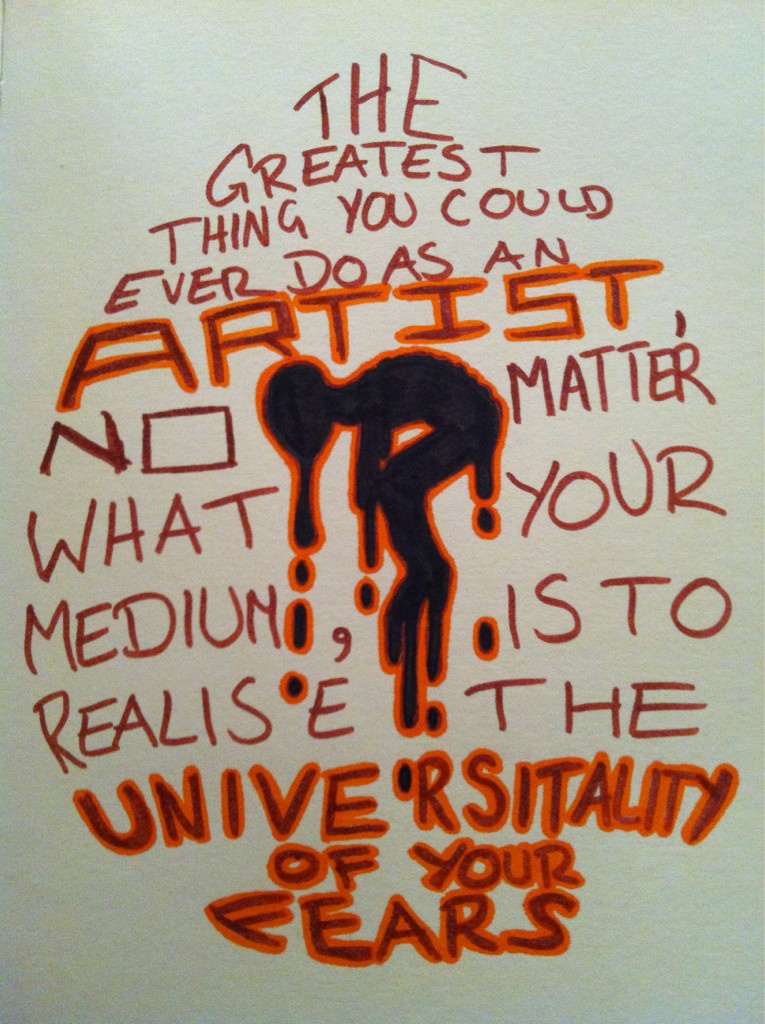

That's right. Whatever your medium, whether it be programming, playing with words, playing with paint, with buildings (but not with yourself), we all have our fears. I've discussed this with my brothers, friends, and I'm pretty sure a few strangers thrown in for good measure. And no matter the output, there is a very real fear that seems to be tagged on to anything that involves taking your mess of thoughts and ideas and turning them into something that represents those thoughts to yourself and others.

In fact, the fear seems to begin even before the point of creation. It's having the thoughts that you think are worth expressing in the first place.

At the start of this year and throughout the summer, my thoughts were sparking in all directions. I could have ten ideas to write about in the time it took for the thought to ignite.

During the last few months, my mind appears to have become somewhat of a wasteland. What's changed? Why aren't I sparking ideas left, right and centre?

I think it has something partly to do with the fact that my 'pool' of resources on which I can draw to mix 'n' match to create new thoughts and connections has not only dwindled in the last few months, but my critical engagement with those resources has become distinctly gormless. Some of you may know what I'm referring to here. It's the idea that nothing is new, but more new combinations of thoughts and creations that have come before you. We draw our influences from anywhere and everywhere. The more varied sources you have at your fingertips, the more likely it is that you're going to create new connections between them. Whilst I've been reading and trying new things (still on the graphic novels, ladies and gents, as well as a whole host of other films and shows that I would not normally have watched), I appear to have stopped thinking about what I'm reading, and making those connections that normally come quite naturally.

My attention span to finish a book has become non-existent, the happy aimless wandering that I advocate has stopped. I'd quite like to achieve the holy grail of human hibernation, and not need to have an intelligent thought until the sun deems to grace us with its presence again.

There's a fear that if and when I start writing, it will never be good enough, won't be as good as things I've managed to write in the past. Yes, I've written as part of a private work blog I keep, I've written the things mentioned at the start of this post. But I've not truly had that moment that makes me feel the need to grab my laptop or a pen and truly enjoy crafting a piece of writing.

And herein lies the golden nugget of truth behind our fears - the belief that everything we create needs to be gold, and that it will be gold without any practice or pain or hard work. But that's just not the case. As this post from one of my brothers says, we need to recognise the pencilled construction lines that sit beneath the finished piece we often see, the many false starts, the iterations that the pieces have been through. As my other brother's work ethic shows, you don't become a brilliant musician without putting in the hours. Others have said the same thing, and I keep coming back to this post I came across last year called Talker's Block, or this more recent piece from ThoughtCatalog, which act as reminders that writing isn't perfect straight away, but that this shouldn't be a reason not to write.

All of us are writers, in a way that not all of us are musicians, or artists. We all craft our little Facebook statuses, or write emails to friends and colleagues. We don't get writer's block when we write these. And yet for those of us that enjoy writing longer, or more 'creative' or 'thoughtful' pieces, or crafting a story, as soon as it comes to putting cursor to screen or pen to paper, we often freeze.

And so, at the end of this rambling piece, the best I can say to those with 'the fear' (and by "us", I mean "me". I've got my own problems to deal with without worrying about your creative block as well), is practice in private first if you're fearful of practicing in public. Do what my bothers do, which is practice their craft every day. It won't be perfect every time, but don't be afraid of failing or mistakes - it's how you improve. For writers, a private blog or handwritten diary to yourself will break down the wall. Just write. Create. Be bad.

And if this awful piece of writing can't get you going, here's some links to what other people have said and written that I've collected over the last year. And why not go ahead and share your own fears, your own antidotes at the bottom of this piece. Recognise the universality of your fears.

A 5-Step Technique for Producing Ideas


And finally, this brilliant video from Neil Gaiman:


Saturday, 3 November 2012

In defence of the lie-in

The problem with waking up is the awareness that you have indeed awoken, which creeps up inside of you whilst your eyes are still shut to the outside world. Your eyes being closed should trick the rest of you into realising it’s made a heinous mistake, and thusly cause it to recoil back into sleepdom. But there appears to be an inverse relationship between the tighter you screw your eyelids and the raising awareness of the fact that you have indeed awoken.

One eye decides to test the water, and cracks the door open just a little.

7:17?! Who wakes up at 7:17 on a Saturday!

The right eye reports back to the left the seriousness of the situation. There’s only one thing for it. The body turns over, sighs a little, and retreats further into the duvet.

The left eye winks open to see if the feint has been successful.

This just won’t do.

The mind gets bored with the whole upsetting façade, and decides to wander.

And this, my dear friends, is the beauty of the lie-in. Cast aside all notions of a day wasted, and any guilt of the productive and interesting things you could be doing. Revel in the feeling of being tucked in between your sheets, duvet folded around you, perhaps one leg out to keep from overheating, your eyelids gently closed, and your mind free to wander and wonder, without the guilt of listing all the other more important things awaiting you outside of the bed.

I could turn this into a lesson, and lecture on how boredom is supposed to be good for creativity or how night owls have been found to have higher IQs, therefore justifying the need to lie in after a week of very late nights and enforced early mornings.  Or provide insight on my own experience, which is that the long weekend mornings spent lolling around in bed are the mornings when my wandering mind starts to gain insight into areas left unsolved from during the week, or when I can spend time browsing through various Twitter feeds, or reading articles marked to read but not yet read. And how both these things are essential elements of where new ideas come from.

But those of us that either dabble or embrace this sordid past time don't lie there thinking, "Ah yes, excellent, I can already feel my creativity increasing by a rate of 0.75 per minute of boredom." Nor do we smile smugly to ourselves as we think of all those early birds rushing about with their low IQs, being all productive and cultural and what-not, whilst we lie in our musty sheets and covered in a slight sweaty sheen. Or, "Right! Time to get productive on the old idea-factory line. A few more hours in bed ought to do the trick."

No, rather we have decided to reject any feelings of guilt associated with staying in bed beyond the thirty seconds it takes to decide whether you're going to embrace the day or embrace your pillow. And we simply enjoy the feeling, and the time to ourselves (or with whoever it is that you've decided to share a bed with). We know we could be shopping, or cleaning, or exhibition-visiting. But we'd rather not. And so we don't.

And that's the crux of it. We know that we enjoy lying in until whatever time constitutes a lie-in. We know that we enjoy dozing, napping, pretending the busy outside world doesn't exist for a while. And so we embrace it. No apologies, no justification, no excuses. Just pure, unadulterated, unfettered,  laziness. And so you may judge, those of you who get up at 7:00 on a Saturday morning to make the most of the day and cram in as much as you can into the weekend, or those that force yourselves out of bed early during the week to exercise or watch the news or eat breakfast. But I think we all know who the real winners are in the scenario. Yep. The real winners. 

Tuesday, 9 October 2012

Revolution on hold

There's nothing like a touch of writer's block to make you realise that those dreams you harbour of retreating to a remote beach to spend your days writing great tomes that inspire people all around the world, and raking in the pounds off the back of it, are possibly a tad misjudged.

As the days and then weeks pass, you find yourself justifying the fact that you appear to be building up an impressive collection of untouched ideas and half-started stories. What's that? No, I couldn't possibly sit down to write now. I mean, Arsenal's on the television. And it's been a long day at work. And that pile of freshly-bought books that's accumulating by my bed isn't going to read itself you know. How could you even think to suggest that I take the time to write?! How irresponsible! How naive!

You begin to read back over the lucky pieces that held your attention long enough to be finished. You marvel, wondering who it was exactly that was inspired enough to pick up that pen and write, as it certainly couldn't have been you.

And so, whilst my writer's block fights the good fight, here's a little something that I wrote a few months back that I'm sharing now to try maintain the facade that I'm a budding authoress just waiting to be discovered and plucked out of obscurity. Now if you'd excuse me, I need to return to the book I'm forcing myself to finish.

****************************** 


Ah the beauty of the manifesto. Such a simple and yet powerful tool. For those that find themselves to be of a creative disposition (that’s right, I’m referring to you), there’s some particularly goosebump-inducing ones around at the moment. With many of them,you’ll surface in the real world only to realise that, in the four minutes it’s taken you to read the piece, you’ve somehow decided to become a Beat writer in the style of Jack Kerouac, or joined a community of ukulele players, or started to make jewellery out of discarded toenail clippings.

They have the ability to make you question everything you thought you believed in. You’ll find yourself nodding along emphatically in unison with the lyrical genius that assembled the words, who could only have had a root around in your subconscious whilst you were looking the other way wondering what to eat for dinner.

By way of illustration, here’s a few that I’ve come across in my travels that made me realise that I’ve clearly been living my life in entirely the wrong way; that I need to reject my current lifestyle, and take up a life of whim, spontaneity, and other related synonyms:

The Holstee Manifesto

The Incomplete Manifesto for Growth

The Right Brain Manifesto

And then, whilst on a plane hurtling towards a week of sunshine and relaxation – after writing a somewhat pretentious and ranting monologue about the absence of curiosity in some people – I found myself writing my own non-manifesto, aimed at touting the joy of being a little ‘intense’ once in a while. Oh yes. I may not have the ability to design an achingly beautiful poster, but I shall fell empires with the truth of my pen. Artists! Writers! Office workers! Milkmen! Viva la revolution!

What makes you happy?

What do you find beautiful?

What inspires you?

Who inspires you?

How do you best express yourself?

What do you enjoy creating?

What do you question?

Do you ask people what they think and feel? Do you listen to their answers?

Do you question yourself? What excites you, what scares you?

When was the last time you spoke about ideas instead of the weather or what you did over the weekend?

How do you feel when someone questions what you’ve said?

Do you ever let your mind wander and ponder?

Do you ever verbalise, picturise, musicise, or writicise your wanderings and ponderings?

What do you think about life, the universe and everything?

How do you feel about intensity of conversation, intensity of thought, intensity of connection with another person?

How do you interpret the world around you, the things you see, the things you hear?

Are you still learning? Who from, what from, how?

Does what you learn excite you, do you ever want to share it, talk about it? Does it ever make you realise how much more you have to learn?

Are you open to new ideas, to being inspired, to questioning, to expressing, creating, to making mistakes, to acknowledging what makes you happy, to not answering these questions but to using them as a way of looking beneath and beyond that which you see?

Are you human? Are you reflective? Are you unique? Are you afraid of being judged?

Are you machine?

Can you think for yourself?

Are you looking for a manifesto?

This is not a manifesto.

Write your own manifesto.

Sunday, 2 September 2012

"Judge not, that ye be not judged"

I'm not one for writing book reviews; as much as I have an unhealthy obsession with reading, I'm always loathe to share the full depth of my opinion of a book with the wider world. If I haven't enjoyed a story, far be it for me to attempt to colour someone else's opinion who may well find something in it that I never could. And if I want to recommend a book, I can't assume that, just because whatever I've just read has made me giddy with excitement, that everyone else should automatically agree with me. The way we experience what we read is fluid; it's influenced by what we've read before, what's happening in our lives, what's happened in our lives, our values, our culture. My unique experience of a book is, by definition, unlikely to match your unique experience. This is why on this blog you'll be forced to read love letters to books themselves and about how reading forms an integral part of my diet, but no reviews.

I am, however, about to break my own principle. Of all the things I've read since I started this blog, the novel that's been coming to bed with me, accompanying me on the Tube, and lying in the park at my feet over the past five days is one that has caused me to finally break my silence. About half way through reading it, I knew I'd feel compelled to share my opinion once I'd read the final few words, closed the covers, and fanned through the pages before putting it down. I seek to not only make sense of my own experience of reading it, but for the first time to hopefully inspire others.

First, in the interest of full disclosure, a little background information about the writer who is now seeking to influence you. I am prone to navel gazing. I have been known to be quite intense, favouring conversations of abstract concepts, surrealism or witty banter over practical topics. I dabble in inappropriate innuendos. I enjoy unpicking underlying themes and connecting seemingly unrelated events in stories (not in a 'conspiracy nut' way, but in an English teacher 'foreshadows' way).  I wear contact lenses. I occasionally get serious bouts of acne. These two latter pieces of information mean that, if it wasn't for the wonders of optometry and skincare, I'd be a spotty four-eyed girl (sexy, I know. It's the song Van Morrison should have written). All this, as you will see, is highly relevant to my review.

The novel I've just finished could have floated the Titanic after the iceberg. Okay so perhaps I also dabble in hyperbole and inappropriate references, but you get the gist. Here's a quick checklist of some of the themes and references that had me grinning inanely to myself:
  • The argument for intelligent design, also known as the Watchmaker Analogy
  • Questions of free will and determinism related to our actions now and in the future (and in the past if you want to be pedantic)
  • Arguments of morality and what it is that makes human 'human'
  • How branding and consumerism relates to societal upheaval and customer buying habits
  • The arguments for and against nuclear deterrents
  • Questions of when it is appropriate to intervene in military conflicts
  • The vagaries of celebrity culture
  • How sentiment analysis can provide insight into public opinion and used as a decision-making tool
  • The causal relationship between the media and public opinion
  • The importance of adopting a wider view of the world around us, and the impact of acting without having full knowledge
In fact, here's a quote from the novel itself on the miracle of each of our's existence:
"… in each human coupling, a thousand million sperm vie for a single egg. Multiply those odds by countless generations, against the odds of your ancestors being alive, meeting, siring this precise son, that exact daughter… until your mother loves a man… and of that union, of the thousand million children competing for fertilisation, it was you, only you, that emerged…. But the world is so full of people, so crowded, with these miracles that they become commonplace and we forget… We gaze continually at the world and it grows dull in our perceptions. Yet seen from another's vantage point, as if new, it may still take the breath away."
And yet, I had to be forcibly cajoled into picking up this book. In fact, I'd go further than that. I was effectively 'double-teamed' into reading it by two people who were inappropriately passionate about it. One of them felt compelled to give me an ad hoc crash course in the history of the novel and the genre (you, yes you. I hope your punishment of being made to sit on the grass has taught its lesson). I found myself having to defend how I'd managed to read Fifty Shades of Grey before reading the novel in question (1 star on Goodreads ladies and gents, and it was only read because the Kindle edition was so cheap and I was on holiday). My response was the result of the quickest piece of thinking I think I've ever done: I'd resisted Fifty Shades on principle, only caving because I knew I'd be able to read it in 24 hours with little effort and then move on with my life. This novel, however, I was not resisting on principle but because I knew that when I finally got round to reading it I'd have to focus a considerable amount of attention to it. I'd not yet found myself in a frame of mind that would allow me to pay it the care it deserved.

You'll notice that thus far I've managed to skilfully avoid providing the name of this amazing, deep, intellectually stimulating story. This is deliberate. It's a book that I was embarrassed to bring out in public, to read on the Tube. I had to keep telling myself that I have resolved to embrace new experiences and things this year, and for god's sake, man up, it's just a book.

So now for the big reveal.

The book that I've spend this week reading was one that popped my comic book cherry.

It was Watchmen.

The two people who had been haranguing me to read it were two boys with glasses. When I discreetly pulled the book out to a colleague who works in IT, his face lit up like a child on Christmas Day (… or like a comic book reader who's just discovered the possibility that all around him women are hiding copies of Watchmen in their handbags).

Despite my quick-thinking argument about why I hadn't managed to read it yet, I'd been resisting reading Watchmen on the grounds that I was cynical, and thought it was just a book full of superheroes beating each other up and gratuitous sex. This was mainly based on my repressed memory of watching Watchmen the film, but also based on every stereotype of comic books and comic book readers you've ever heard. I had to remind myself that I like to think of myself as an open-minded individual, who doesn't have a leg to stand on when it comes to accusations of being a geek (including the spots/glasses image).

As you can probably tell by now, I genuinely enjoyed it (she says through gritted teeth). The themes and references that came out had me smiling in pleasant surprise more times than I care to remember. Those that I've picked out above are just the ones that stood out for me. I'm sure someone else reading it would take something else away. The writing was indeed beautiful on more than on occasion. In several places there are three different layers to the story positioned next to each other in a single frame, told by a narrative, dialogue and picture from three completely different parts of the story. This allows a depth of complexity of meaning that you would struggle to achieve in a normal novel, as the three different contexts play against each other. As a result, it engaged me in a way that not many other books have done. And whilst there wasn't a single frame that involved scenes of embarrassingly explicit sex, there was enough clever word play to keep me happy.

As I was enjoying the story more and more, I found myself wondering why it was that I was struggling to read it in public. What was I afraid of? Judgment from strangers that I'll never see again? A fear that people would make assumptions about me based on the connotations associated with reading a comic book? Why did I feel the need to look particularly suave and well-dressed/groomed whilst I was reading it? I came to the conclusion that it was the fact that the pages are dominated by the art of the novel, and it wasn't a style that sat easily with me. I didn't find the imagery particularly pleasing, not in content but in form. Of course, appreciation of art in any of its guises is subjective. With my head I can appreciate the skill with which the artwork of Watchmen has been executed. With my heart I feel it caused a tension in my enjoyment of the book.

I know now for a fact that this won't be my last graphic novel (a question to connoisseurs: is there a difference between a comic book and a graphic novel? I'm assuming yes but shall use them interchangeably here, protected by my naive ignorance). Particularly as an ill-advised journey to Waterstones earlier this week saw me casually glancing over the shop's selection to see what else is out there. There were some interesting-looking titles, including ones related to the conflicts we read about in the news. I also figured I'm an avid lover of Christopher Nolan's Batman trilogy, I adore the themes that come out in V for Vendetta, so why not embrace the format that these were originally written for.

And so my dear reader, I ask one favour of you, from one non-comic book reader to another. If you've never read a graphic novel but you're a lover of books, and enjoy being challenged by what you read and made to think, then put aside all your preconceived ideas, all your judgments, all you thought you knew about comic books and those that read them. Embrace the theme of this blog, which is to nurture your curiosity. Find yourself a copy of a graphic novel that you think you'll enjoy (I've been reliably informed that V for Vendetta is probably a better cherry-popper than Watchmen). Perhaps don't take it out in public if you're not yet ready, but put it by your bed and, when no-one else is looking, safely hidden under your duvet covers and with a torch, open up the pages and be prepared to dive into a world you may find it hard to turn away from.


Couldn't help but share this one


Monday, 27 August 2012

'I keep six honest serving-men...'

Another musing, this time from by the Thames whilst waiting for someone to finish work on a Friday evening a few weeks ago. Because I'm that way inclined. And apparently sitting by water does peculiar things to me when I have a notebook and pen close at hand.

It had been inspired by a phone conversation the evening before where a friend had found himself having a debate in a pub. Over the phone afterwards, we'd subsequently begun our own debate on what it is people are seeking to do when they argue. 


Many are afraid to not be seen to have an opinion, to admit ignorance on a topic. And so up and down the country, in pubs, restaurants, coffee houses, living rooms, in beds, you can hear arguments on politics, religion, the economy, distant military conflicts, the right way to brew a cup of tea.

I truly think that we defend our subjective feelings with rational arguments to justify that which we wouldn’t change when faced with contradictory evidence. We argue and defend our position, attack that of our opponent, rather than listen, question, reflect. We rarely ask ourselves, ‘Why does the person I’m talking to hold their view? How are they constructing their argument in defence of it? Is there any merit to it?’

How many of us can admit to ourselves and to each other that we sometimes use our intelligence as a weapon to clothe gut feelings in rational thought, backing it up with what we deem to be empirical evidence? Is he who shouts most eloquently always right?

And if one is right is the other consequently intrinsically wrong? Why must we divide into opposites, into black and white? We argue, defend, become offended, attack. But who knows the full picture of any situation? It feels as though there must be a supreme ignorance in assuming you know all there is to know about any given topic or situation.

We argue opinion rationally, and so ask yourself: would you change your stance if presented with a  logic that revealed flaws in that opinion? Or would you acknowledge that there’s arguments against the view you hold and continue holding it regardless? And if this is the case, why carry on arguing, attempting to persuade others that your way is the right way when it is likely that, like you, they are unlikely to change their position? Are you debating to elucidate, or are you arguing to humiliate, to convert? If the latter, pause to question yourself. Why are you seeking to convert, to humiliate? Are you so incredulous at someone else’s opinion that you feel you must enlighten them, show them the error of their ways? Or have they attacked you first, and you’re on the defensive?

And so, rather than arguing, attacking, defending, simply waiting your turn to speak, let me make a quiet suggestion: we can recognise the power and strength of questioning. Instead of blinding your opponent with facts, general knowledge, negative assumptions about their viewpoint, we can try truly listening to their position. Why do they think what they think? Are there deep-set assumptions sitting behind their argument, ideologies, are they cherry-picking their facts? Can we challenge through questioning, not through arguing? Are we able to make them think through the implications of their own argument, see the different sides? 

Listen. Question. Summarise. Find connections between seemingly disparate points, find logical flaws in their argument, take opinions to their logical conclusions. Play devil’s advocate, agree with them, test opinions you don’t believe in. All these things can be done without taking up a position in opposition to the person you’re talking to, which will at some point need to be defended. Rather than argue, you can work together to debate a point of controversy and work out why it’s a point of controversy; rather than seeking to embarrass, batter down, win, you can have an open conversation where the end isn’t a forgone conclusion.

And, if done skilfully enough, if you’re able to lead them down a path of thought with your questioning, you may just convert them to your way of thinking.


And just to sign off, here's a few lines from Rudyard Kipling and a few verses from a Tim Minchin song, on questioning and straddling:

I KEEP six honest serving-men
(They taught me all I knew);
Their names are What and Why and When
And How and Where and Who.


I'm taking the stand in defence of the fence
I got a little band playing tributes to ambivalence
We divide the world into liberals and gun-freaks
Into atheists and fundies
Into tee-tot'lers and junkies
Into chemical and natural
Into fictional and factual
Into science and supernatural
But it's actually naturally not that white and black

You'll be
Dividing us into terrorists and heroes
Into normal folk and weirdos
Into good people and pedos
Into things that give you cancer and the things that cure cancer
And things that don't cause cancer, but there's a chance they will cause cancer in the future
We divide the world to stop us feeling frightened
Into wrong and into right and
Into black and into white and
Into real men and fairies
Into parrots and canaries
Yeah we want the world binary, binary...

The more you know, the harder you will find it
To make up your mind, it doesn't really matter if you find
You can't see which grass is greener
Chances are it's neither, and either way it's easier
To see the difference when you're sitting on the fence