Showing posts with label books. Show all posts

Sunday, 22 June 2014

Books + Covers + Judging = Well-known phrase

I'm just going to go ahead and say it: I'm a sucker for good ("good" obviously being entirely subjective) design. Hold up. Not just good design. I'm a sucker for clever design. For design that has been thought-out with its intended audience firmly in mind. For design that is unabashedly there as a marketing ploy, whether it is an idea that's being sold, a message, a product, a service.

The best illustration of this that I can think of can be found in my book-buying behaviour.

I believe I'm on the verge of a bank-destroying book-buying binge.  Emails confirming the dispatch of goods bought are popping up in my inbox. Padded envelopes have started appearing on my frontdoor mat. And after the initial cheeky grin that accompanies the opening of the envelope, which is swiftly chased by surprise at the book that's now in my hands ("I do not remember ordering this. Someone's sending me books through the post in a passive-aggressive manner, surely? I've obviously picked up the world's nicest stalker!"), an inevitable sinking feeling hits as I remember the night three days before that found me entering my card details for this object. Do I really need this edition of Romeo and Juliet, which was bought purely because the design included laser-cut images of key scenes? What precisely am I going to do with a copy of 100 Ideas that Changed Graphic Design? On which Sunday afternoon am I actually going to sit down and read Magnificent Maps: Power, Propaganda, and Art? This isn't healthy, surely?

My bookcase has actually become unusable, with books haphazardly stacked in front of and on top of books. I'm not entirely sure of the contents of the case anymore, and any attempt to mine a particular vein will undoubtedly result in a collapse of horrific proportions. And I'm not ready to be crushed by a pile of books of which the majority have not even been read yet.

They're obviously organised using the standard Dewey Decimal Classification system.
There's a deeper issue at stake here, to do with buying physical books to simply own them, and the comfort of having your books around you as a projection of who you are, what your interests are, what you want your interests to be. I'm sure this is how Nick Hornby's protagonist Rob feels in High Fidelity, surrounded by his categorised vinyl records.

But the reason I'm mentioning this behaviour is that, because I can now recognise the beginnings of a binge, I have determined to avoid all book shops for the near future. I know that if I find myself making my way into one of these havens of temptation whilst in the grips of my fever, I will inevitably be making a furtive exit half an hour later, with a heavy bag accompanying me. In that bag will be books that I either already own but have now bought in a well-designed edition, and/or books that I have never heard of and had no intention of buying, bar from the fact I was drawn to them by their cover and then convinced by the blurb that they are books that I should own and read.

And this is the crux of it: I reckon you can judge a book by its cover (and here's an article from 2011 agreeing with me; hooray for validation). Those covers have been designed with a set audience in mind. There's a language of book covers, just as there's a language of film posters. In the colours chosen, the fonts, the imagery, the publishers are saying that the contents will appeal to a particular demographic. The dozens of copy-cats that emerged after the success of Fifty Shades of Grey all had a *very* familiar style to their jackets. Those adventure books, fantasy series, romantic stories, all of them use a very particular design vocabulary to communicate their genre in a blink of an eye to those that speak the language.

So, here's to the artists who so callously lure us in with their limited edition covers for books we already own. Here's to the publishers such as Foyles who provide heavily bounded books at a purse-busting price. And here's to those bibliophiles who will continue to binge buy their books, no matter the Kindle that is our more common travel companion.

Tuesday, 24 December 2013

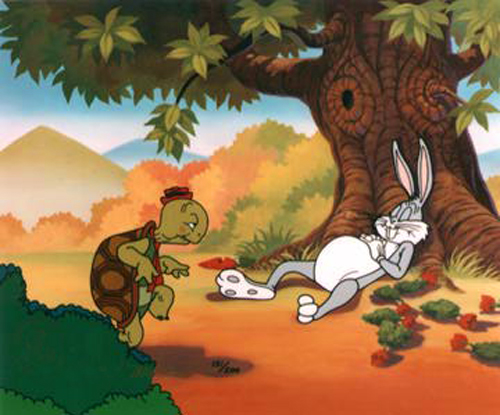
In a race between the Tortoise and the Hare...

Have a read of this:
It was a pleasure to burn it was a special pleasure to see things eaten to see things blackened and changed with the brass nozzle in his fists with this great python spitting its venomous kerosene upon the world the blood pounded in his head and his hands were the hands of some amazing conductor playing all the symphonies of blazing and burning to bring down the tatters and charcoal ruins of history with his symbolic helmet numbered 451 on his stolid head and his eyes all orange flame with the thought of what came next he flicked the igniter and the house jumped up in a gorging fire that burned the evening sky red and yellow and black.
And - breathe.

How quickly can you devour a book? If you are reading something at the same time as someone else, do you feel an unspoken pressure to be the first to finish; to show that you can consume the most amount of content in the least amount of time? Do you consider yourself the consummate reader for being able to finish a book in a few days, or perhaps a week if it's heavier tome?

I know, without a doubt, that you are out there, my friends. And that you secretly revel in the art of your speed read. 

For I am one of you. 

And I have experienced the showdown of a silent speed read, eyes and printed word, mind and internally whispered word barely touching fingertips as you race to the end of the page, then wait smugly, casually for your contender to finish.

Putting articles to one side, let's focus on the reading of fiction; the picking up of a book, or e-reader, in which a writer has built a world and story through their words, and put those words in your hands to be read and absorbed. If you've experienced "that deeply intimate bond made when a writer's voice gets inside a reader's head" (Julian Barnes, A Life with Books) then presumably you've experienced what it is to lose yourself in a written world, and become intimately acquainted with its populace. 

This is one of the joys of reading fiction. Much as a film pulls you into a story, so too does a (good) book, whether a simple piece read to pass the time, a classic, a dystopia to learn about the perils of today, anything. And, "the true reader reads every work seriously in the sense that he reads it whole-heartedly, makes himself as receptive as he can." (C S Lewis, An Experiment in Criticism). To absorb yourself, you find yourself unconsciously tuning out the world around you, what you are hearing, touching, smelling. The ink (or pixels) on the page become a gateway to the writer, with each word and punctuation mark deliberately chosen by them to describe, 'work out loud', share the world that has emerged within their own minds. 

And yet, I often find myself guilty of speed reading my way through. Of ignoring the rhythm with which the writer has written, skimming over the words that they - and their copyeditor - have undoubtedly pained and fretted over. The experience often becomes one of impressions, where you get a blurred feel for the story, rather than a sharp focus on the voice of the writer. 

The paragraph at the top of this post. Here it is again, with Ray Bradbury's punctuation and paragraphing included (taken from the first page of Fahrenheit 451). Read each word, feel each comma, and hear the words spoken in your mind, as though being read to you by someone else, read with a passion and with emotion, with music in their voice. Resist the urge to skip or skim words, to get to the end of the italicised text as quickly as possible.
It was a pleasure to burn.
     It was a special pleasure to see things eaten, to see things blackened and charged. With the brass nozzle in his fists, with this great python spitting its venomous kerosene upon the world, the blood pounded in his head, and his hands were the hands of some amazing conductor playing all the symphonies of blazing and burning to bring down the tatters and charcoal ruins of history. With his symbolic helmet numbered 451 on his head, and his eyes all orange flame with the thought of what came next, he flicked the igniter and the house jumped up in a gorging fire that burned the sky red and yellow and black.
The pace of reading, compared to the first paragraph, is tangible. The impact on the feeling it makes considerable. The story emerges in full technicolour, with its sounds, smells, colours. You can feel the sharp coldness of the brass nozzle, see the numbers '451' etched into the helmet, hear the flames erupt around the house. 

And that is the art of the slow read. For those of us used to speed reading, it is an art that we often have to consciously remind ourselves to do, and to practice. To battle against the urge to finish the book as quickly as possible at our own pace, and to have the pace dictated to us by the writer instead. To feel each word as a connoisseur of art feels each brush stroke, or of wine feels each subtle taste, or of music feels each layered instrument's timbre and each note's resonance. And to lose ourselves in amongst the ink and paper (... or pixels and hardware) for a little longer that we would have otherwise done.


Tuesday, 21 February 2012

Crack that spine every which way

The feeling of painfully surfacing in the real world in a busy coffee house, or on the Tube, or in fact even in your own bed, after being immersed in a captivating book is the same feeling as being dragged from a deep sleep. You suddenly feel slightly unsure of where you are, the time of day, who you are, or when and how you managed to consume a full bag of Doritos.

This isn't about my love of reading, however. Although I'm sure at some point I'll be writing a love letter to this raunchy pastime of mine.

Instead, as my aversion to cold weather has massively impaired the amount of wandering around London I've been doing, it's about books themselves.

Before I go any further let me settle the book versus Kindle debate once and for all. I've had conversations with a few people about this, and most seem to fall down on one side or the other. I know of one person in particular who resents being given actual books if they can be bought on a Kindle. When debating with him, I found myself responding with an embarrassingly soppy homage to libraries in defence of books. I know others who refuse to go anywhere near a Kindle, for fear it'll be cheating on their analogue friends. I then find myself becoming an ambassador for Amazon, seemingly hell bent on earning as much commission from sales as possible.

I have a Kindle. I adore it. But this doesn't mean it's either/or. It can be both.

Now, I know a number of people who like to make sure the spines of their books remain unbroken. They carefully keep their books in pristine condition, making sure they never bend the covers too far and always use an appropriate bookmark to mark their place. They contort themselves into obscene positions to peer at the words rather than risk damaging the pages. My best friend once texted me purely to share the pain she was experiencing watching the woman sat opposite her on the Tube bending her book. 

But I love books that have been passed around, bent, torn, been dropped in baths and dried on a radiator, have questionable stains, illegible scribbles in the margins, and carefully worded personal messages inside the front cover. 

These dear 'book preserver' friends of mine look at me in horror as I gleefully twist my paperbacks into positions the Spanish Inquisitors could have learnt a thing or two from, and dog ear my pages. If I borrow one of their books, from the look of fear in their eyes as they reluctantly hand it over you'd think I was about to throw the pages onto a bonfire and commit the ultimate sacrilege in setting alight to them. My response to my best friend's text about the book-abuser on the Tube? I threatened to break into her flat in the dead of night and break all the spines of the books on her shelves. For her own good, of course. Not to satisfy a slight sadistic streak I appear to harbour.

I can't help it. It's similar to how I feel about notebooks. I have a slightly inappropriate emotional/nostalgic attachment to books. There's an enjoyment in abusing them or picking up a book that's seen a few years and a few owners and a few tea spillages. It seems cruel to not personalise the pages with your experience of reading the contents. It's that inextricable connection with where you were when you read the story, who you were with, or which holiday you were on, how the story made you feel. And when you re-read the book it's remembering how a particular mark was made, or coming across bits of sand, or an old receipt that you hurriedly used as a bookmark.

But it's not just abusing your own books, but coming across books that have been abused by others. I once found myself spending over an hour in an area of Camden Stables browsing the shelves of a second-hand book shop. I guiltily left with a bag full of books, including two that had been signed by the author, for the cost of buying one new hardback. I recently bought an 1980s edition of George Orwell's Down and Out in London and Paris from eBay that cost £2 and has a beautiful crease down the front cover. I've ruined books that I've given as gifts by writing a message inside to the new owner, making the book just that little bit more personal. Again, it's that knowledge that the object you're holding has a history, that someone else has held the pages and read the words, or could do in the future. The Kindle is fantastic for consuming just the story. The preserved book is a way of having the words there, in your hands. The abused paperback, however, is a way of truly immersing yourself in the journey of the book and the experience of the story.

So there you have it. The simple joy of holding and abusing books, whether they're yours or someone else's.

And as I've spend most of this railing on about books as opposed to reading, here's a lovely little video about Girls Who Read to readdress the balance.